How True Odds and Casino Payouts Differ on Every Craps Bet
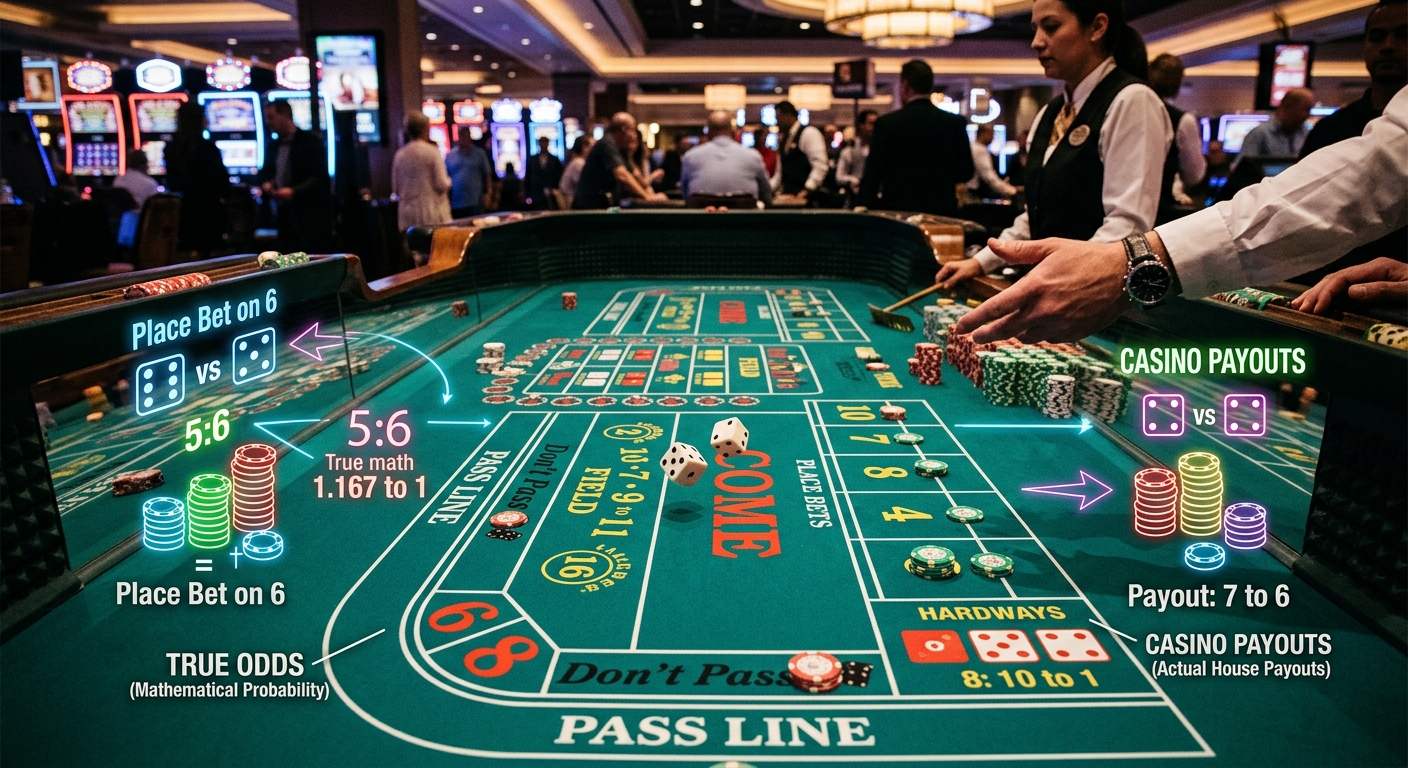
The craps felt does not lie, but it does omit. Every bet on that layout pays you less than neutral probability says it should, and the difference between those two numbers is the only thing standing between you and a fair game. Knowing where that gap lives, and how large it runs on each specific bet, is the whole game within the game. This article walks through the math bet by bet so you can stop guessing and start knowing.
The Payout Gap at a Glance
- True odds are what a neutral game would pay; casino payouts are always trimmed below that mark.
- The pass line carries a 1.41% house edge , among the lowest available in any casino game.
- Place bets on 4 and 10 carry a 6.67% house edge, nearly five times worse than the pass line.
- Free odds bets pay at true odds with zero house edge , the single best bet a craps player can make.
- Sports bettors can translate craps payout ratios directly into decimal odds to immediately gauge a bet's value.
What True Odds Really Mean Before You Touch the Table
True odds are simply what a neutral payout looks like when neither side holds an advantage. A coin flip is the clearest case: two outcomes, equal probability, and 1:1 pays both parties exactly even over time. Craps extends that same principle across 36 possible two-dice combinations. Some numbers appear often. Some appear rarely. The ratio of losing outcomes to winning outcomes for any given bet is its true odds, and a fair payout would match that ratio exactly.
The number 4, for example, can only be rolled three ways: 1+3, 2+2, and 3+1. The number 7 can be rolled six ways. That means for every three times you would hit a 4 before a 7, six times you would not. True odds against place 4 run at 2:1, meaning a fair game pays $2 for every $1 wagered. The casino pays 9:5 instead, which works out to $1.80 per dollar. The gap between the fair $2.00 and the actual $1.80 is precisely where the 6.67% house edge on place 4 comes from. Every craps bet has a version of that same gap, just varying in size.
The Pass Line: The Friendliest Edge in the Casino
The pass line is where most players start, and it also carries the smallest bite the house takes on any standard craps bet. On the come-out roll, a 7 or 11 wins immediately. A 2, 3, or 12 loses. Any other result , 4, 5, 6, 8, 9, or 10 , becomes the point, and the bet stays alive until that number repeats or a 7 appears first.
Running all 36 dice combinations through every possible sequence, a pass line bet wins on 244 out of 495 total decision paths and loses on 251. That puts the chance of winning at roughly 49.3%. A fair payout would be slightly better than 1:1 to compensate for that imbalance. The casino pays 1:1 exactly. The small shortfall between what the math says and what the casino pays produces a house edge of 1.41%. That number is genuinely low. The pass line is not a trap , it is the closest thing to a fair fight the casino offers.
Place Bets: Where You Pick Your Number and Pay for the Privilege
Place bets let you skip the come-out roll entirely and bet directly on a specific number hitting before a 7. That convenience costs you, and the price rises steeply as you move away from the 6 and 8.
Place 6 and place 8 are the most competitive of the group. Each number can be rolled in 5 combinations, against 7's 6. True odds run 6:5 against you, meaning a fair payout on a $5 bet would be $6. The casino pays 7:6, so you need $6 at risk to win $7. That works out to $1.1667 per dollar rather than the fair $1.20. The shortfall produces a house edge of 1.52%, only slightly worse than the pass line and worth considering if you want action on a specific number.
Place 5 and place 9 step it up. Each rolls in 4 combinations against 7's 6, giving true odds of 3:2 against you. A fair payout on a $2 bet would return $3. The casino pays 7:5, meaning you need $5 to win $7. That is $1.40 per dollar against a fair $1.50. The house edge sits at 4.0%, roughly three times worse than the pass line. Many experienced players treat the 5 and 9 as secondary bets they reach for only when the table is running hot and they want more coverage.
Place 4 and place 10 carry the steepest standard price. Three combinations each, against 6 for the 7, produces true odds of 2:1. The casino pays 9:5, not 2:1. That shortfall builds a house edge of 6.67%. A player sitting at 6.67% per bet is giving back roughly $6.67 for every $100 they cycle through those numbers. Seasoned players often avoid straight place bets on 4 and 10 for this reason, preferring to buy those numbers instead when the commission structure makes it worthwhile.
Free Odds: The One Bet Where the Casino Blinks
After a point is established on the pass line, most casinos allow an additional bet placed directly behind the original wager. This is the free odds bet, and it stands apart from every other bet on the layout: the casino pays it at true odds, with no house edge whatsoever.
If the point is 4 or 10, free odds pay 2:1. If the point is 5 or 9, they pay 3:2. If the point is 6 or 8, they pay 6:5. These are precisely the fair payouts that neutral math would produce, not a trimmed-down version. The casino cannot profit from free odds itself. Its profit comes entirely from the original pass line bet out front.
Casinos cap free odds as a multiple of your pass line bet, typically labeled 1x, 2x, 3x-4x-5x, or higher. The higher the multiple you can take, the more of your total risk sits in a zero-edge bet, which mathematically compresses your combined house edge on all money at risk. Taking full 3-4-5x odds behind a pass line bet brings the effective edge on your total action down to roughly 0.37%. That is the best position any craps player can legally hold at a live table, and it requires nothing more than knowing the bet exists and using it.
Bridging the Gap for Players Who Come from Sports Betting
Sports bettors think in American moneylines. A +150 line means a $100 bet returns $150 in profit, or $250 total. Converting to decimal odds gives 2.50. Converting to implied probability gives 40%. All three formats describe the same bet , the format is just a matter of habit. Craps payouts express the same relationships as ratios, and they convert cleanly into decimal form.
A pass line paying 1:1 is 2.00 in decimal odds, identical to a -100 moneyline or a straight coin flip. A place bet on 6 paying 7:6 converts to 2.1667 decimal (because you return your $6 stake plus $7 winnings, totaling $13 on a $6 bet). True fair odds on that same bet would give 2.20 decimal ($5 stake plus $6 winnings, totaling $11 on a $5 bet). You can convert sports odds into any format you prefer and immediately see that a 2.1667 payout against a fair value of 2.20 is a small but permanent leak.
That framing is useful because sports bettors already carry strong intuitions about pricing. A bettor who would immediately flag a -200 favorite being paid at -170 terms understands craps edge just as sharply once the numbers are in a familiar format. A place bet on 5 at 7:5 is 2.40 decimal. Fair value is 2.50 decimal. The ten-cent spread in decimal terms is the same 4.0% edge expressed differently. Nothing new to learn , just a translation.
Putting the Math to Work Before Any Real Money Is on the Line
Reading these numbers in an article gives you one layer of understanding. Actually placing the bets, watching the edge accumulate across dozens of sessions, and building intuition for which bets belong in your game is an entirely different layer. That second layer is where free-play simulation earns its value.
A browser-based craps simulator lets you run through hundreds of pass line decisions, free odds combinations, and place bet sequences with no financial consequence. You can test whether taking 2x odds versus flat pass line play changes your session results in ways you can actually feel. You can watch the 6.67% edge on place 4 drain a bankroll compared to the 1.41% on the pass line across a 50-roll session. The probability breakdown for every point number has been verified and published in detail, but your instincts only absorb that math through repetition.
Simulated play is not a replacement for understanding the math. It is the environment where the math stops being abstract and starts behaving like something real. Arriving at a live table without that repetition is like reading about swimming technique and then jumping into the deep end expecting to feel comfortable.
Every Bet Has a Price Tag: Knowing Yours Changes the Game
The core reality of craps is straightforward: every standard bet except free odds is priced in the house's favor. The pass line is priced modestly. Place bets on 5, 9, 4, and 10 are priced progressively more steeply. Free odds exist as a genuine anomaly , a bet the house offers at cost because it keeps you engaged and wagering on the pass line underneath.
Knowing the exact price of each bet does two things for you. First, it lets you structure your session around lower-edge positions, which directly slows how quickly your bankroll erodes. A player on the pass line with full free odds and a couple of place 6 and 8 bets has positioned themselves in a fundamentally different game than one throwing money on place 4 and 10. Second, it gives you a realistic picture of what each session actually costs, which makes bankroll management a real discipline rather than a guess.
The craps table is one of the most transparent games in the building once you hold the conversion in your head. The numbers are not hidden. They are right there in the payout schedules and felt markings. The gap between true odds and casino payouts is simply the price of the game. Knowing that price exactly, bet by bet, is the edge an informed player carries before a single die leaves their hand.
🎲 Put it into practice: roll at a free craps table, brush up on the rules, or take on the daily challenge.