Craps Bets Ranked by House Edge from Pass Line to Proposition Bets
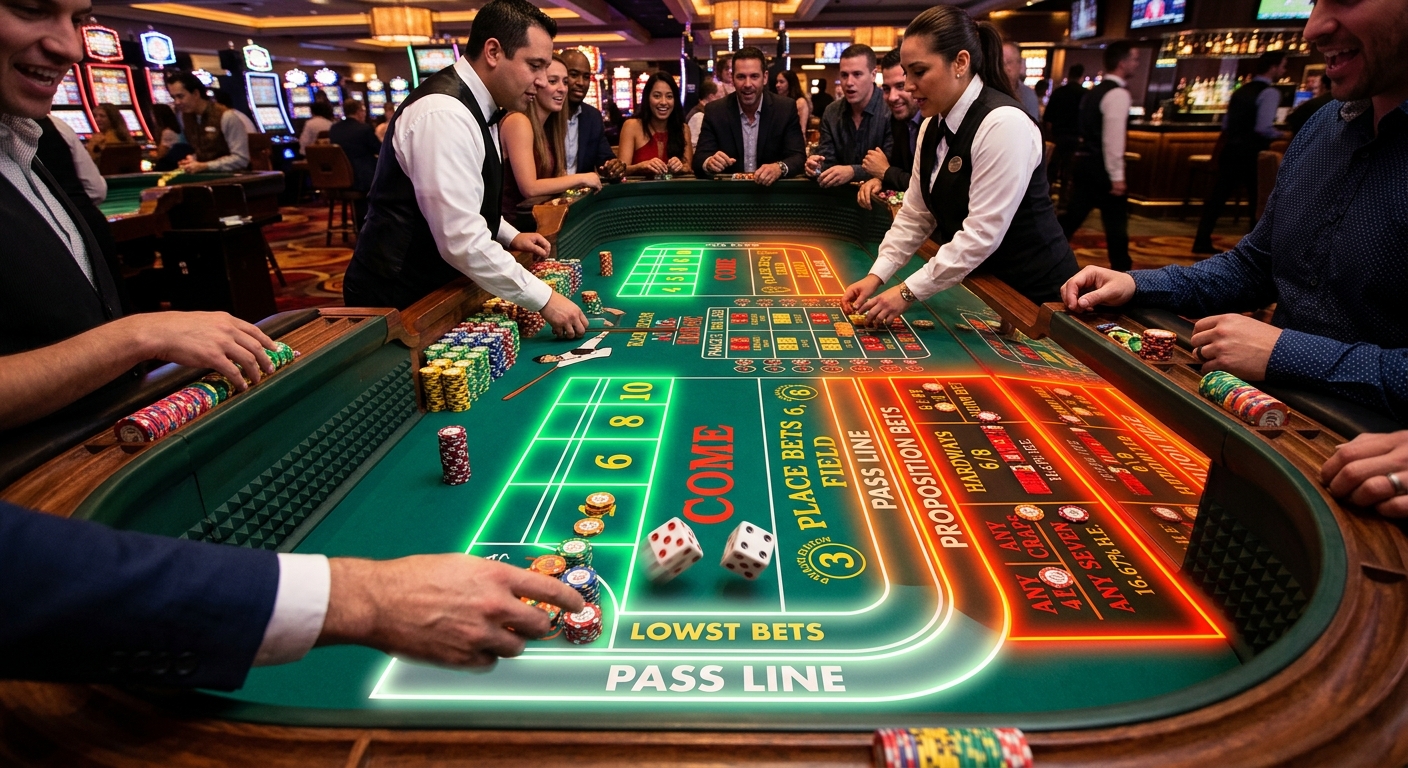
The craps table looks like chaos at first. Numbers everywhere, a crowd shouting, and dealers moving chips at lightning speed. But strip away the energy and you find something surprisingly logical at the core. Every bet on that layout has a number attached to it. That number tells you exactly how much of each dollar the casino expects to keep over time. Master that number and you turn a noisy guessing game into a structured, repeatable strategy.
Edge Essentials
- The pass line bet carries a 1.41% house edge, making it one of the best wagers in any casino game.
- Free odds bets carry a 0% house edge and should always be added behind your pass or come bet when your bankroll allows.
- Proposition bets can carry house edges above 16%, costing far more per dollar than any other wager on the layout.
What the House Edge Actually Means for Your Bankroll
House edge is not a fee you pay upfront. Think of it as the casino's expected return, measured as a percentage of every bet you make. A 1.41% house edge on the pass line means that, across thousands of decisions, the casino expects to keep $1.41 for every $100 wagered. That sounds small, because it is, relative to most casino games.
The gaming research produced by UNLV's Center for Gaming Research confirms that craps offers some of the lowest house edges available at any table in the casino, provided you stick to the right bets. That phrase "provided you stick to the right bets" is doing a lot of work. Craps also offers some of the worst bets in gambling. The gap between the best and worst wagers on a single craps table is staggering, and closing your eyes to it costs real money.
The Bedrock Bets: Pass Line and Don't Pass
Start here, every single session. These two bets form the foundation of every serious craps strategy.
The pass line bet wins when the come-out roll is 7 or 11. It loses on 2, 3, or 12. Any other number establishes the "point," and the shooter must roll that number again before rolling a 7 to win. The house edge sits at 1.41%.
The don't pass bet is the mirror image. It wins on 2 or 3, pushes on 12, and loses on 7 or 11 on the come-out roll. After a point is established, you want the 7 to appear before the point repeats. The house edge drops slightly to 1.36%, making it technically the sharper bet of the two.
The practical difference between 1.41% and 1.36% is negligible in a short session. Pick the one that makes more intuitive sense to you and stay consistent with it.
Come and Don't Come Bets: Same Math, More Action
Once a point is established, the come bet gives you a chance to start a fresh mini-game within the same round. Place a come bet, and the next roll becomes your personal come-out. The same rules apply: 7 or 11 wins, 2, 3, or 12 loses, and any other number sets your come point.
The come bet carries the same 1.41% house edge as the pass line. The don't come mirrors don't pass at 1.36%. These bets let experienced players get multiple numbers working simultaneously, which adds real excitement to a hot roll without sacrificing the math.
Free Odds: The Only Zero-Edge Bet in the Building
This is the single most important concept any craps player can internalize. After placing a pass line bet and establishing a point, most casinos allow you to add an "odds" bet directly behind your original wager. This additional bet pays at true mathematical odds, meaning the casino takes zero profit from it. The house edge on a free odds bet is literally 0%.
Payouts depend on the point number:
- Points of 4 or 10 pay 2:1
- Points of 5 or 9 pay 3:2
- Points of 6 or 8 pay 6:5
Most casinos allow odds bets of 2x, 3x, or even 10x your original wager. A pass line bet backed with 3x odds drops the combined effective house edge on your total action to approximately 0.47%. At that level, craps genuinely competes with blackjack as one of the best-value games on the floor.
Place Bets and Their Widely Varying Costs
Place bets let you wager directly on a specific number: 4, 5, 6, 8, 9, or 10. The house edge varies dramatically by number. Place 6 and Place 8 are the most defensible, sitting at 1.52%, just barely above the pass line. Place 5 and 9 at 4.0% are already four times more expensive. Place 4 and 10 at 6.67% make no mathematical sense unless you simply enjoy watching those specific numbers hit.
Every Major Craps Bet Ranked by House Edge
| Bet Type | House Edge | Tier |
|---|---|---|
| Free Odds (behind pass or come) | 0.00% | Always Add |
| Don't Pass / Don't Come | 1.36% | Always Consider |
| Pass Line / Come | 1.41% | Always Consider |
| Place 6 or Place 8 | 1.52% | Use Strategically |
| Field Bet (double on 2 and 12) | 2.78% | Use Sparingly |
| Place 5 or Place 9 | 4.00% | Use Sparingly |
| Place 4 or Place 10 | 6.67% | Entertainment Only |
| Big 6 / Big 8 | 9.09% | Entertainment Only |
| Hardways (6 or 8) | 9.09% | Entertainment Only |
| Hardways (4 or 10) | 11.11% | Entertainment Only |
| Any Craps | 11.11% | Entertainment Only |
| Any Seven | 16.67% | Avoid |
Field Bets, Big 6, and Big 8 Cost More Than They Appear
The field bet attracts beginners because it covers so many numbers: 2, 3, 4, 9, 10, 11, and 12. Covering seven numbers feels like great odds. The problem is that 5, 6, 7, and 8 are the most frequently rolled numbers on a pair of dice, and none of them win a field bet. At standard payouts, the house edge sits at 2.78%. In casinos that only double on 2 and pay even money on 12 (or vice versa), it climbs to 5.56%.
Big 6 and Big 8 deserve special mention because they are genuinely unfair traps. They cover the same territory as place 6 and place 8, but they pay even money instead of 7:6. That payout difference alone inflates the house edge from 1.52% all the way to 9.09%. These bets survive on the layout because players do not realize the payouts differ. If you want a 6 or 8 working for you, always place it through the dealer instead.
Proposition Bets: Fast Decisions with a Long-Term Cost
Proposition bets sit in the center of the layout and resolve on the very next roll of the dice. The speed is part of the appeal. The house edge is part of the danger.
Any Craps wins if the next roll is 2, 3, or 12 and carries an 11.11% house edge. Any Seven is probably the worst bet offered at any standard table game. It wins only when the next roll is a 7, paying 4:1 instead of the true 5:1 odds. That gap between the real probability and the payout produces a house edge of 16.67%. For every $100 you cycle through Any Seven bets, the casino expects to keep $16.67.
Hardway bets require the shooter to roll a specific doubles combination, like 2+2 for a hard four, before rolling a 7 or the easy version of the number. They pay attractively but carry edges between 9% and 11%. Horn bets bundle 2, 3, 11, and 12 into a single wager and average over 12% in edge.
None of this means proposition bets are forbidden. A single hardway winner on a big bet makes for a great moment. The issue is treating them as part of a system rather than a spontaneous treat.
Building Low-Edge Combinations into a Repeatable Approach
Knowing the numbers is step one. Using them under the pressure of a live table is step two, and the gap between those two things is wider than most players expect. The energy, the dealer's pace, and the crowd create constant pressure to make bets you know you should skip. A dealer offers you a hardway, someone at the end of the table bets Any Seven, and suddenly the correct choice feels less obvious.
Closing that gap requires repetition at zero cost. Taking time to play craps on a free simulator lets you hardwire these patterns before real money enters the picture. Practice sticking to pass line plus maximum odds. Add come bets after the point is established. Ignore the proposition section entirely. Do this a hundred times and the decisions start to feel automatic, which is exactly the state you want when you sit down at a real table.
Repetition builds instinct. Instinct keeps your chips on the right side of the felt when a dealer slides a hardway tile your direction at the worst possible moment.
The Tiered Betting Framework: Your Decision Tool from Day One
Use this ranked list to make every bet decision faster and cleaner, whether you are in your first session or your fiftieth.
- Always consider: Pass line and don't pass. These are your anchor bets every session. Back them with the maximum free odds the table allows and your overall edge drops as low as 0.47%.
- Use strategically: Come and don't come bets with odds. Add these after a point is established to get multiple numbers working while keeping your mathematical disadvantage minimal.
- Use sparingly: Place 6 and Place 8 at 1.52% are reasonable when you want those numbers active without waiting for a come point to land there. Place 5 and 9 at 4.0% are borderline and only worth considering when table conditions genuinely restrict your come bet options.
- Treat as entertainment: Field bets, hardways, and place bets on 4 and 10. Budget a small portion of your session money for these if you enjoy them, then stop. They are not strategies.
- Avoid entirely: Any Seven and Big 6 / Big 8. There is no scenario in which these bets become mathematically reasonable. The casino counts on players not knowing that.
From the Layout to a Lifelong Betting Compass
House edge is not a concept that belongs in a textbook. It is a practical tool that directly determines how long your money lasts and how much value you extract from every session you play. A player running pass line plus 3x odds is facing a fundamentally different game than a player cycling through hardways and Any Sevens, even if they are standing at the same table.
The numbers here do not change. A 16.67% edge on Any Seven is the same in every casino in every city. That consistency is genuinely useful. It means you can build a strategy once, drill it until it feels automatic, and carry it confidently into any craps game you ever sit down at. The layout changes, the dealers change, the crowds change, but the math is always the same underneath it all.
Start at the top of the tier list. Max out the free odds every time. Let the proposition bets stay in the center of the layout where they belong. Your bankroll will last longer, your decisions will feel cleaner, and the table that once looked like chaos will start to look like an opportunity you actually know how to use.
🎲 Put it into practice: roll at a free craps table, brush up on the rules, or take on the daily challenge.