How Casino Craps Builds on the Social Dice Games You Already Play
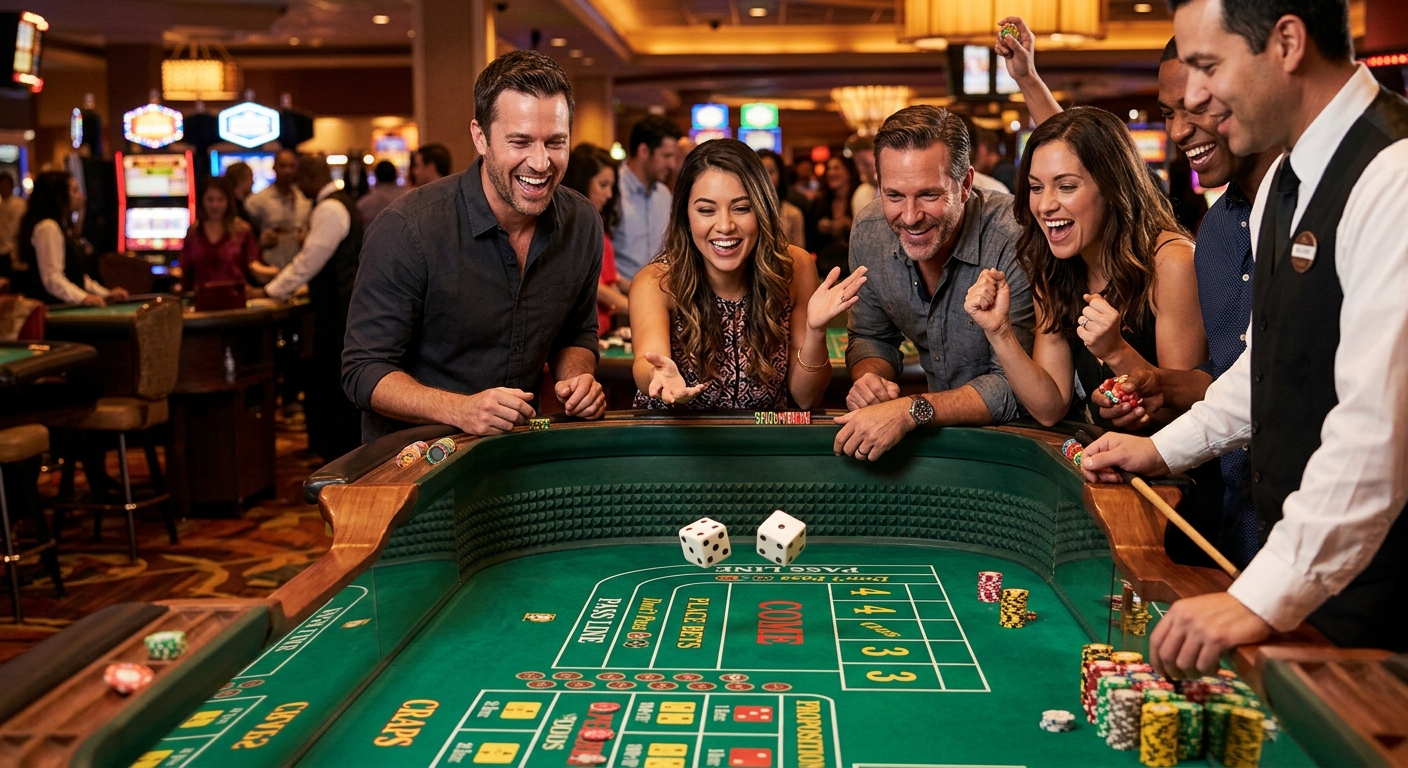
Everyone leans toward the dice before they stop moving. Someone needs a six. Someone else starts cheering too early. You count the spots, check the rules, and wait for the next turn. If you have played dice at a family gathering, a party, or a bar, you already know that feeling. Casino craps takes that shared suspense and gives it a structured betting system. The atmosphere feels familiar. The decisions need a little more care.
Your Head Start With the Dice
- Group dice games teach you to follow shared outcomes.
- Craps adds changing roll conditions and measurable betting costs.
- Free practice helps you test those instincts before risking money.
The Shared Roll Is Already Familiar
Many casual dice games put one person in charge of an outcome that affects everyone. The roller takes a turn. Other players watch, count, react, and prepare their response. Even when everyone has a separate score, the roll becomes a group event.
Craps follows that rhythm. One player, called the shooter, rolls two dice. Other players can make bets on what those dice will produce. You can participate without holding them yourself. Several people may back the same outcome and celebrate together when it arrives.
That connection helps explain the noise around a craps table. Players are following overlapping stories. One person wants the shooter to repeat a target number. Another has a bet that depends on the very next roll. Their chips share the same dice, but their rules can differ.
Your useful starting skill is attention. You already know how to watch a turn, read a total, and connect it to a rule. Craps asks you to track one extra detail: which rule applies right now?
The Casual Games That Give You a Head Start
You do not need a casino background to bring useful habits to craps. Different games teach different parts of the experience. A family scoring game can sharpen your counting. A party game can teach you to follow changing conditions. A push-your-luck game can make you notice how excitement affects your decisions.
- Yahtzee: Counting dice and checking scoring categories builds comfort with reading a result before reacting.
- Farkle: Choosing whether to bank points or continue rolling makes exposure to loss feel concrete.
- Liar’s Dice: Thinking about plausible outcomes encourages attention to probability, though craps offers no comparable bluffing advantage.
- Left Center Right: Following one roll that redistributes chips makes shared outcomes and turn order easy to understand.
House rules vary, especially at parties and bars. Browsing social dice games gives that broader category a familiar reference point. The connection to craps is the shared experience of rolling, interpreting results, and responding as a group.
The limits of that connection matter. Farkle may let you stop rolling and preserve points. A standard craps pass-line bet becomes committed once a point is established. Liar’s Dice rewards reading people. Craps payouts depend on dice outcomes and bet rules. Bring your attention and patience. Check every borrowed assumption.
The Pass Line Gives Each Roll a Clear Job
The pass line is a useful starting point because its story has two stages. First comes the come-out roll. If a point is established, the game shifts into a race between that point and seven.
These are standard casino craps rules. Other variants can change them.
- Place a pass-line bet before the come-out roll. A seven or eleven wins immediately. A two, three, or twelve loses immediately. Any four, five, six, eight, nine, or ten establishes the point.
- Follow the point. Once established, that number must appear again before seven for your pass-line bet to win.
- Wait for resolution. Other totals leave this bet unresolved. Repeating the point wins. Rolling seven first loses.
- Track the next stage. Making the point starts another come-out roll, usually with the same shooter. A seven-out ends that shooter’s turn.
Suppose the come-out roll totals eight. Eight becomes the point. A following three does not lose your pass-line bet. An eleven does not win it. Those numbers had immediate meanings during the come-out stage, but now your bet waits for eight or seven.
This is where casual game experience helps most. You already understand that a number can mean different things under different conditions. Craps turns that familiar idea into a precise betting rule.
The Numbers Behind the Cheers
Two fair six-sided dice produce 36 equally likely ordered outcomes. A one followed by a six and a six followed by a one count as separate outcomes. Both total seven.
Seven has six combinations. Six and eight each have five. Five and nine each have four. Four and ten each have three. That uneven distribution shapes the game.
If the point is eight, five combinations make eight and six make seven. Ignore the rolls that produce neither number. Among the outcomes that resolve your pass-line bet, eight accounts for five out of eleven. Your chance of making that point before seven is therefore 5/11, about 45.45%.
A point of four is harder to make. Three combinations produce four, against six for seven. Four wins that race one-third of the time.
A crowded table cannot change these probabilities. Neither can a long stretch without a seven. With fair, independent rolls, previous results do not make a number due. The social energy changes how a roll feels. It does not change the dice.
Odds Bets Add Depth to a Familiar Wager
After a point is established, you can usually add an odds bet behind your pass-line bet, within the table’s limit. It wins or loses with that point. Its payout reflects the true probability of making the point before seven.
How the Point Changes Probability and Payout
| Point | Chance of Beating Seven | Odds Bet Profit Payout |
|---|---|---|
| 4 or 10 | 1/3, about 33.33% | 2 to 1 |
| 5 or 9 | 2/5, or 40% | 3 to 2 |
| 6 or 8 | 5/11, about 45.45% | 6 to 5 |
Take a $10 pass-line bet with eight established, then add $10 in odds. If eight arrives before seven, your pass-line profit is $10 and your odds profit is $12. Your original $20 also returns. If seven arrives first, both bets lose, costing $20.
The odds portion has zero house edge because its payout matches its probability. For a $10 odds bet on eight, the calculation is five-elevenths times $12, minus six-elevenths times $10. The result is zero expected profit.
Zero house edge does not mean zero risk. You can lose several odds bets in a row. It also does not remove the house edge from the pass-line wager required to access them.
House Edge Gives Your Instincts a Price Tag
The standard pass-line bet has a house edge of about 1.41%. Across repeated resolved $10 bets, that means an average theoretical loss of roughly 14 cents per bet. An individual bet still wins $10 or loses $10. The percentage describes an average across many outcomes, not a charge taken from each roll.
Adding odds lowers the house edge expressed as a percentage of the combined amount wagered. It does not reduce the expected dollar loss attached to your original pass-line bet. You are adding a wager with zero expected loss while increasing the amount exposed to a losing outcome.
This creates a real tradeoff. A larger odds bet offers better mathematical value than many other wagers, but it also makes each resolved loss larger. Choosing a smaller pass-line stake can leave room for odds without stretching your session budget.
Other bets sell a different kind of excitement. A standard Any Seven wager paying 4 to 1 has a house edge of about 16.67%. It wins on six of the 36 outcomes and loses on thirty. The payout falls short of the true 5 to 1 odds against winning.
That gap is what casual dice instincts cannot tell you on their own. A dramatic payout can feel attractive while carrying a much higher expected cost.
Group Energy Can Help Your Attention or Push Your Bets
A shared game makes learning easier when someone explains the current point or helps you follow a payout. It becomes less helpful when cheering pressures you to increase your stake.
Set a session limit before play. Decide how much you will risk on one resolved sequence. Keep those decisions separate from whether the shooter seems lucky. A winning streak does not make the next wager safer.
You can also enjoy the group without matching every bet. Watching one pass-line wager through several rolls often teaches more than scattering chips across unfamiliar sections of the layout.
At a live table, place bets while betting is open and keep your hands clear once the dice are moving. Ask the dealer about placement or payout increments before committing chips. Familiarity with dice helps, but table procedure takes practice too.
Give Your Dice Instincts a Free Rehearsal
The craps.now simulator makes a useful bridge between casual games and casino rules. Free practice gives you room to test what you think a roll means, then check the result without losing money.
Start with classic casino craps and follow only the pass line. Before each roll, name the stage and the outcomes that would resolve your bet. Once that feels natural, add modest odds and predict the payout before it appears.
Practice through losing sequences as carefully as winning ones. Notice whether a seven-out makes you want to raise your next stake. Compare your decisions with the session limit you set. Free chips let you study that reaction without paying for it.
Save other variants for after the standard rules feel comfortable. Different versions can change which numbers establish points or how wagers resolve. Checking those differences is part of becoming a confident player.
The habits you built around party dice already give you a starting place: watch the roll, read the number, follow the turn, and share the suspense. Craps adds a sharper question before every wager: what outcome am I buying, and does the payout match its risk? Practice that question for free before taking it to a live table.
🎲 Put it into practice: roll at a free craps table, brush up on the rules, or take on the daily challenge.