The Dice Game Variants That Serious Craps Players Should Know About
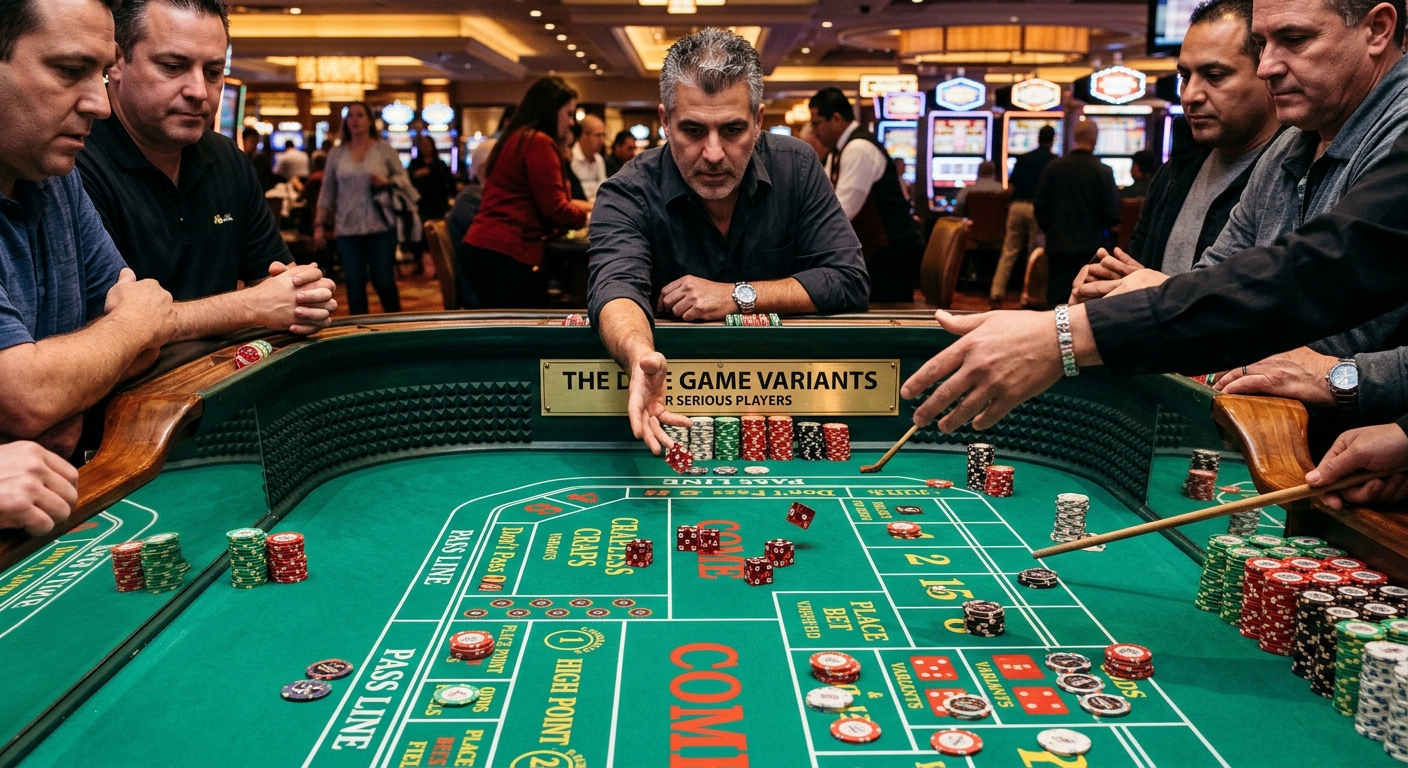
Most craps players find their groove at the standard table, master the pass line, learn the odds bet, and never look sideways. That works fine for recreational play. But the players who develop a deeper feel for the game tend to have broader dice game experience under their belt. Learning what lives outside the standard game is one of the fastest ways to tighten your instincts at it.
At a Glance
- Casino variants like crapless craps and New York craps shift house edges dramatically, making them useful benchmarks for understanding why standard craps rules are structured the way they are.
- Hazard, the English predecessor to modern craps, introduced the core probability logic that still drives every come-out roll today.
- Parlor and tabletop multi-die scoring games sharpen the expected-value thinking that transfers directly to craps betting decisions.
Why Broader Dice Knowledge Pays Off at the Standard Table
Understanding a game variant is not the same as endorsing it. You do not have to play crapless craps to benefit from knowing how it works. The value is comparative. When you see how dramatically the house edge shifts under a different ruleset, the logic behind the standard game's structure becomes clearer. Rules that once seemed arbitrary start to feel purposeful. That shift in comprehension shows up as better instinct when you are actually at a table making real decisions under pressure.
There is also the question of encounter probability. Travel players, competitive gamblers, and anyone hitting regional casinos will run into dice game variants without warning. Knowing what you are looking at before you sit down is worth real money. A player who has studied the field walks into an unfamiliar format with a working framework already assembled. That saves both time and chips.
These variants also expose the invisible architecture of standard craps. The standard game is not the only possible design. It is one carefully tuned version among several. Understanding the alternatives is what allows you to see that tuning clearly.
Crapless Craps and What It Actually Costs You
Crapless craps sounds like a player-friendly innovation. The name implies you cannot crap out on the come-out roll, and that is true. Roll a 2, 3, or 12 on the come-out, and instead of losing outright, those numbers become point numbers. Roll an 11, and that becomes a point number too. The automatic loser outcomes from the standard come-out are restructured entirely.
The house does not give that away for free. In standard craps, rolling a 7 or 11 on the come-out is an automatic win. In crapless craps, only the 7 wins outright on the come-out. The 11 becomes a point, just like 2, 3, and 12. Because 7 outranks 11 in combinatorial frequency, the math shifts hard against the player. The pass line house edge in crapless craps climbs to approximately 5.38 percent. That compares to 1.41 percent on the standard pass line. The odds bet is still available on all point numbers, including 2, 3, 11, and 12, but the payouts on those extreme numbers are unfavorable enough that they rarely offset the come-out disadvantage.
What crapless craps teaches you is how sensitive the house edge is to come-out roll outcomes. The standard game's structure, where 7 and 11 win and 2, 3, and 12 lose, is not arbitrary. It is carefully balanced. Seeing what happens when that balance shifts makes you appreciate why experienced players protect the pass line bet so carefully. The come-out roll is not just the beginning of a sequence. It is where a meaningful chunk of the bet's long-run fate is decided.
New York Craps and the No-Odds Format
New York craps has a geographic footprint that reflects its history. You find it along the East Coast of the United States and through much of the Caribbean. The rules look similar to standard casino craps on the surface, but two key differences define the experience.
Come bets and don't-come bets are not available. Free odds are not offered either. Instead, players use buy bets on specific numbers, paying a five percent commission on winnings. That commission structure pushes the effective house edge up significantly from standard play. The buy bet on the 5 or 9 carries a house edge around 4.76 percent. On the 4 or 10, it sits in a similar range after the vig is applied. For a player accustomed to backing their bets with free odds at zero house edge, the numbers in New York craps feel like a different game entirely.
What New York craps illustrates is how much value the free odds bet adds to the standard game. Players who play standard craps without ever backing up their pass line or come bets are effectively playing a version of the game not far removed from New York craps in terms of edge. The free odds bet is one of the most player-favorable bets in the entire casino. New York craps shows what the game looks like without it, and that contrast is a powerful argument for always taking the maximum odds you can afford.
Hazard, the Game That Shaped Every Come-Out Roll
Before there was craps, there was Hazard. The game traces back to at least medieval England and was documented in detail by the 17th century. Its core mechanic should look familiar. A shooter called a "caster" would roll a pair of dice against a chosen target number called the "main." Certain rolls would settle the bet immediately. Others established a "chance," a secondary number the caster then had to hit again before rolling the main. That structure is the direct ancestor of the craps come-out roll and the point phase.
The journey from Hazard to craps runs through New Orleans in the early 19th century, where Hazard's core rules were simplified and adapted into the game that spread up the Mississippi River and into American casino culture. The come-out roll logic, the concept of a point, the basic win-and-lose structure all descend from Hazard in a recognizable line.
Playing a Hazard simulation is genuinely illuminating for craps players because you can watch the probability logic in near-identical form without the modern casino overlay. The main-and-chance structure feels almost like reading an older translation of a book you already know. The vocabulary is different but the underlying story is the same. That recognition alone tends to deepen how players understand the rhythm of the craps table.
Parlor and Tabletop Games That Train Dice Intuition
The probability instincts that make a craps player sharp do not only develop at a craps table. Multi-die scoring games force players to constantly evaluate expected value across multiple outcomes, and that kind of thinking transfers cleanly to the table.
Take Kismet dice game play as a reference point for this. Five dice are rolled across multiple turns, with players building specific scoring combinations from a set of categories. Each roll presents a decision point. Keep which dice? Roll which again? Chase a high-value combination or secure a lower-scoring but guaranteed result? Every choice is an expected-value calculation. The player is constantly asking: what is the probability I complete this pattern, and is the payoff worth the risk of losing what I have already locked?
That cognitive pattern maps precisely onto craps decisions. Should you press a place bet or take it down? Do you back a long-shot number at full odds or reduce exposure? Craps players who have spent time with multi-die scoring games tend to run those calculations faster, not because they memorized tables, but because the decision structure feels familiar. The mental groove is already there.
Other parlor dice games build similar muscle. Farkle requires players to evaluate whether accumulated points justify continued rolling or whether greed will wipe the score clean. Liar's dice, while a bluffing game, builds sharp intuitions about dice distribution across multiple unseen dice. These are not craps, but they develop adjacent probability fluency that pays off at the table. The instincts trained in a living room or on a phone carry over when the stakes go up.
How the House Edge Shifts Across Casino Dice Variants
Holding pass line house edges side by side across the main casino craps variants makes the structural contrast hard to ignore. The numbers below frame the core differences in plain terms.
| Variant | Pass Line House Edge | Free Odds Available | Come-Out 11 Outcome |
|---|---|---|---|
| Classic Casino Craps | 1.41% | Yes | Automatic win |
| Crapless Craps | ~5.38% | Yes (all point numbers) | Becomes a point number |
| New York Craps | ~4.76% (via buy bets) | No | Automatic win |
| Hazard | Variable by main | No standard structure | Depends on main chosen |
What Serious Players Take Away From the Full Dice Landscape
The through-line across all of these games is probability logic. Each variant manipulates the same underlying dice outcomes in a different direction, and each reveals something specific about why the standard craps structure works the way it does. Crapless craps shows what removing come-out losses costs you in expected value. New York craps shows what the game looks like when free odds disappear. Hazard shows where the entire framework came from. Parlor scoring games build the mental habits that make odds calculations feel instinctive rather than effortful.
Serious players do not stop at the standard table. They accumulate context. Every variant they understand adds a new reference point that makes their standard game sharper. The math does not change at the table, but the ability to read it clearly absolutely does. Spending time with these adjacent games is not a detour from craps. It is one of the more direct paths to playing it better, because you stop reacting to outcomes and start anticipating them.
🎲 Put it into practice: roll at a free craps table, brush up on the rules, or take on the daily challenge.